

Thermostats • NO / NC
Mechanical Thermostats Normally Open & Normally Closed
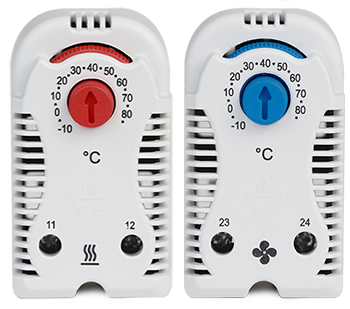
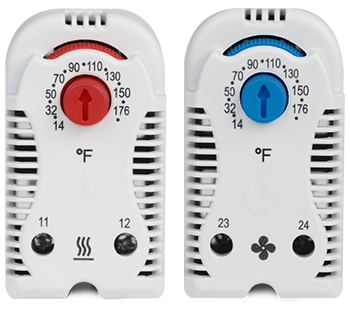
The TTEC series are thermostat controllers used to regulate the temperature inside industrial control panels or cabinets and control cabinet accessories. The TTEC series control fans, heaters, and switch loads. TTEC-100 and TTEC-200 are identical except the TTEC-100 (Red) is Normally Closed which opens at temperature rise, and turns the Heater off, the TTEC-200 (Blue) is Normally Open which closes at temperature rise, and turns the Fan/Fan Filter on.
125-250 Vac
Voltage
16 A
Current
Bi-metallic
Sensor Element
±5°C
Hysteresis
Electrical
Voltage Rating | 125–250 Vac |
Current Rating | 16 A (AC) / 14 A (DC) |
Contact Type | SPST (NO / NC) |
Control Type | Operating control, Type 1 |
Dielectric Strength | 1800 Vac · 1 sec |
Mechanical
Temperature Range | -10 to +80 °C (+14 to 176 °F) |
Hysteresis | ±5°C |
Sensing Element | Bimetal |
Housing Materia | Flame retardant housing, UL 94-V0 |
Colour | RAL 7035, Light Grey |
Dimensions
Length | 47 mm / 1.85″ |
Width | 34 mm / 1.34″ |
Height | 60 mm / 2.36″ |
Weight | 50 g / 0.11 lb |
Mounting & Standards
Mounting | Rail 35 mm / Rail 32 mm / Rail 15 mm |
Terminals | 2-Pole for wires section of 12 AWG |
Standards | UL 60730-1 / UL 60730-2-9 / UL 60730-2-13 CAN/CSA-E60730-1:15 / CAN/CSA-E60730-2-9:15 |
Environmental | Indoor |
Product Spec Sheet
Specifications and key features for quick reference.
Installation Instructions
Operation, safety notes, and troubleshooting.
Product Drawings
Outline drawings with dimensional data.
Industrial Automation & Control Panels
Precision thermal control for automation OEMs and panel builders, protecting critical electronics from heat and condensation.
AI Infrastructure & Data Centres
High-capacity, low-noise cooling to maintain tight temperature tolerances in server racks and AI nodes.
EV Charging Stations
Weatherproof thermal solutions to ensure performance and safety in both indoor and outdoor charger installations.
Aerospace & Defence Enclosures
Rugged, IP and NEMA rated systems for avionics, radar, and control cabinets in mission-critical environments.
Telecommunications & Networking
Reliable cooling and humidity control for telecom shelters, network hubs, and remote facilities.
Food, Beverage & Pharmaceutical Equipment
FDA compliant solutions with hygienic design to safeguard against moisture and contamination in certified environments.
Solar Inverters & Combiner Boxes
Thermal protection for inverters and junction boxes exposed to harsh sunlight and temperature swings.
Water Treatment & Pump Enclosures
Corrosion-resistant heaters, fans, and hygrostats suitable for humid and chemically aggressive conditions.
Transportation & Traffic Control Systems
Durable cooling for cabinets at intersections, highways, and remote signaling, resistant to weather extremes.
What’s the difference between NO and NC thermostats?
NO (Normally Open) closes on temperature rise—commonly used to turn fans on as things get warm. NC (Normally Closed) opens on temperature rise—commonly used to turn heaters off once a minimum temperature is reached.
How do I choose NO vs NC for my enclosure?
Use NC to protect against over-heating of a heater (opens as temp rises). Use NO to start cooling fans when cabinet temperature rises above your target.
What is “differential” (hysteresis)?
The temperature band between switching ON and switching OFF. Example: setpoint 30 °C with 5 K differential → turns ON at 30 °C, OFF at ~25 °C on the way down.
Can one thermostat control both a heater and a fan?
Use two thermostats for independent thresholds (e.g., NC at 10 °C for heater; NO at 35 °C for fan). A dual-thermostat module is also common.
What setpoints are typical in control panels?
Common starting points: Heater NC ~10–15 °C (anti-condensation) and Fan NO ~30–35 °C (electronics comfort). Adjust for climate, load, and component specs.
What differential should I pick?
5–10 K suits most enclosures—small enough to hold temperature steady, large enough to avoid short-cycling.
Do I need a hygrostat as well?
If condensation risk exists, pair a hygrostat (60–65% RH) in series with an NC thermostat near your minimum temp so the heater runs only when humid and cool.
What contact rating do I need?
Size for locked-rotor/inrush (fans can be 3–6× running current; PTC heaters have a brief surge). If in doubt, switch a control relay instead of the load directly.
Can a single thermostat handle multiple fans?
Yes, if the total inrush and running current are within contact ratings. Otherwise, use a contactor/relay.
Where should I mount the thermostat in the enclosure?
Mid-height, away from direct airflow and heat sources, close to the warmest representative spot of the components you’re protecting.
How do I wire a fan thermostat?
Line → COM; NO → fan line; neutral direct to fan. The contact closes on temperature rise to power the fan.
How do I wire a heater thermostat?
Line → COM; NC → heater line; neutral direct to heater. The contact opens on temperature rise to stop heating.
Can I wire a hygrostat and thermostat together?
For anti-condensation: Hygrostat (60–65% RH) in series with NC thermostat set near your minimum temperature → heater runs only when both conditions are met.
Will ambient temperature outside the cabinet affect switching?
Yes—cabinet design, airflow, and thermostat placement influence readings. Avoid cold walls or direct fan streams.
What about vibration and shock?
Mechanical thermostats are generally robust. For high vibration, secure DIN clip, use strain-relief, and consider electronic types for precision.
What’s the best way to prevent condensation in outdoor/food-grade enclosures?
Use NC thermostat near 10–15 °C plus a hygrostat at 60–65% RH controlling a PTC or resistive heater; keep intake fans off while RH is high.
We have two speed zones—can I stage cooling?
Yes—use two NO thermostats at different setpoints (e.g., 30 °C for Fan #1, 38 °C for Fan #2) or one thermostat driving a two-stage controller.
Can I integrate with a VFD or PWM fan?
Use the thermostat to enable the controller (run/stop) while the controller handles speed modulation from a temperature probe.
My fan never turns on even though the panel is hot.
Check NO vs NC wiring, verify supply voltage, confirm setpoint, and ensure the thermostat isn’t in the direct cold airstream from an intake.
Heater runs continuously.
Verify you used NC contact, confirm setpoint isn’t too high, ensure hygrostat series wiring (if used) is correct, and check for welded contacts (sign of overload).
Contacts pitted/burnt.
Load may be inductive or over current. Add snubber/MOV, switch a relay, or upsize the thermostat/relay.